APR vs Others
APR vs EAR: Is the Rate on Your Loan Higher Than You Think?

APR vs EAR: Is the Rate on Your Loan Higher Than You Think?
Two loans can advertise almost the same rate and still cost very different amounts. The reason is usually hidden in three small letters: APR vs EAR. APR is the rate lenders must show you, but EAR is what you will actually pay once interest compounds. Compare APRs only, and you can pick the “cheaper” loan and still pay more. This guide explains both rates in plain English, shows the maths with a worked example, and tells you which number to trust before you sign.
If you are new to the term itself, start with what APR means in plain English — it covers the basics this article builds on.
What Does APR Stand For?
So first, what does APR stand for? APR stands for Annual Percentage Rate. The apr full form is simply “annual percentage rate”, and it is the yearly cost of borrowing expressed as a percentage of the amount you borrow. When a lender quotes you an APR, that figure usually includes not just the interest rate but also certain fees, such as origination fees or closing costs, rolled into one annual number.
What is APR in practice? Think of it as the headline price of a loan. A personal loan advertised at 12% APR costs roughly 12% of the borrowed amount per year in interest and included fees. APR is deliberately simple: it takes the periodic interest rate — say 1% per month — and multiplies it by the number of periods in a year. 1% × 12 = 12% APR. That multiplication is easy to understand, which is exactly why regulators require lenders to disclose it. But it leaves something out: it ignores the fact that interest charged in January can itself earn interest in February. That missing piece is where EAR comes in.
What Is EAR?
EAR stands for Effective Annual Rate. It is the single yearly rate that reflects what you actually pay — or earn — once compounding is counted. While APR annualises by simple multiplication, EAR annualises by compounding: it applies the periodic rate again and again through the year and measures the total growth.
The difference sounds academic until you see the numbers. A loan quoted at 12% APR with interest compounded monthly does not really cost 12% a year. Each month you are charged 1%, and the interest from earlier months starts generating its own interest. By the end of the year, the true cost is 12.68%. That extra 0.68% is invisible in the APR — but it is very visible in your bank balance.
EAR is sometimes confused with APY. The two are close cousins: APY is the savings-side version of the same idea, which is why the apy meaning matters here too — APY tells savers what a deposit truly earns after compounding, just as EAR tells borrowers what a loan truly costs. In apr vs apy comparisons, remember they answer different questions: APR is the cost of borrowing, APY is the return on saving, and EAR is the honest annual figure on either side.
The One Difference That Matters: Compounding
APR and EAR describe the same loan. They differ in exactly one thing: compounding.
- APR multiplies the periodic rate by the number of periods. It assumes interest is charged once, simply, and never earns interest of its own.
- EAR compounds the periodic rate through every period in the year. It counts interest on interest.
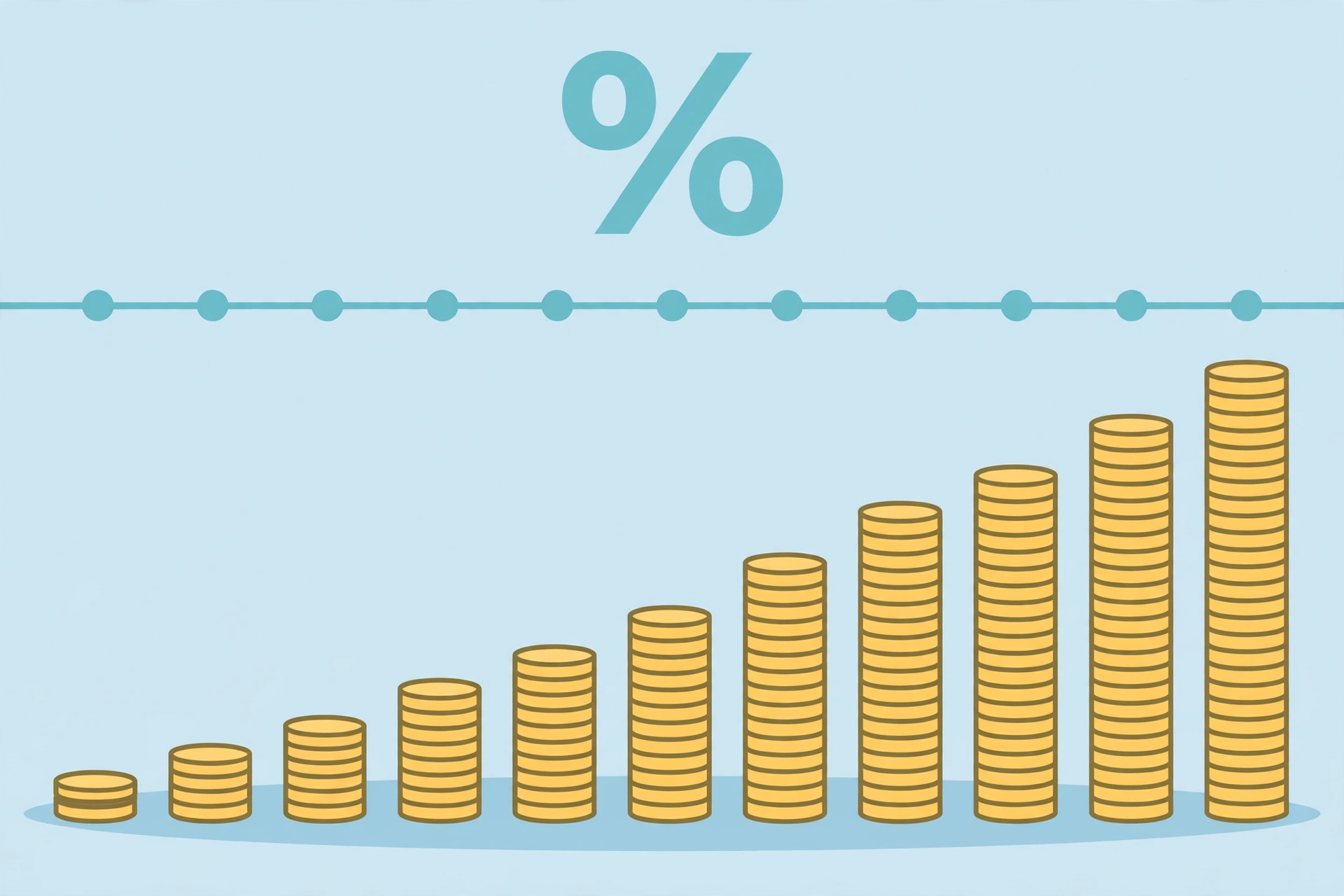
That is why EAR is always equal to or higher than APR. When interest is compounded once a year, the two are identical. Compound monthly, and EAR pulls ahead. Compound daily, and the gap grows again. The more often interest is added, the wider the gap between the advertised APR and the effective rate you actually pay.
The APR to EAR Formula (With a Worked Example)
The conversion is a single formula:
EAR = (1 + r ÷ n)n − 1
Here, r is the nominal annual rate (the APR as a decimal) and n is the number of compounding periods per year. Take a loan at 12% APR:
| Compounding | n | Calculation | EAR |
|---|---|---|---|
| Annually | 1 | (1 + 0.12 ÷ 1)1 − 1 | 12.00% |
| Semi-annually | 2 | (1 + 0.12 ÷ 2)2 − 1 | 12.36% |
| Monthly | 12 | (1 + 0.12 ÷ 12)12 − 1 | 12.68% |
| Daily | 365 | (1 + 0.12 ÷ 365)365 − 1 | 12.75% |
On a $10,000 loan, the difference between 12% APR and 12.68% EAR is about $68 in the first year alone — and the gap compounds year after year on longer loans. Daily compounding pushes the true cost to 12.75%. None of this is a trick by the lender; it is simply what compounding does. The point is that the APR on the advert understates the real cost whenever interest is charged more than once a year.
APR vs EAR vs APY: A Quick Comparison
| APR | EAR | APY | |
|---|---|---|---|
| Full name | Annual Percentage Rate | Effective Annual Rate | Annual Percentage Yield |
| Counts compounding? | No | Yes | Yes |
| Used for | Loans, credit cards, mortgages | True cost of borrowing or return | Savings accounts, deposits |
| Usually higher or lower? | Lower (or equal) | Higher (or equal) | Higher than the nominal savings rate |
| Legally required disclosure? | Yes, for consumer credit | No | Yes, for deposit accounts |
The apr vs apy confusion is common because both are annual percentages, but they point in opposite directions: APR is what borrowing costs you, APY is what saving earns you. EAR is the bridge between them — the effective figure on either side once compounding is counted. A savings account advertising a 4% interest rate with monthly compounding has an APY of about 4.07%, for exactly the same mathematical reason a 12% APR loan costs 12.68% effectively.
Where You Actually Meet Both Rates
Credit cards
Credit cards are where the APR vs EAR gap bites hardest, because card interest is usually compounded daily. How does apr work on a credit card? Your card’s purchase apr — the rate applied to new purchases — is quoted as an APR, often around 20% or more. But because the issuer compounds the balance daily, the effective rate you pay if you carry a balance is higher than the quoted APR. On a 24% APR card compounded daily, the EAR is about 27.1%. That is why carrying a balance is so expensive, and why paying in full each month matters so much: pay in full and no interest is charged at all, so the APR vs EAR question never even arises.
Your card agreement discloses the APR in a standardised box called the Schumer box, named after the senator behind the disclosure law. It lists the purchase APR, balance transfer APR, cash advance APR and penalty APR in one place, so you can compare cards side by side. What it does not show is the EAR — so two cards with the same purchase APR can still cost different amounts.
Mortgages and personal loans
On mortgages and personal loans, interest is typically compounded monthly and fees are folded into the APR. Here APR is the more useful comparison tool, because it captures fees that EAR ignores: a loan with a low rate but heavy fees can have a higher APR than one with a slightly higher rate and no fees. Learn how APR works on a loan to see why two apparently identical loans can cost very different amounts.
What sets your rate
Your own APR is not plucked from thin air. Lenders start from a benchmark — often the prime rate, the rate banks charge their most creditworthy customers — and add a margin based on your credit score and the type of loan. Excellent credit might get prime plus 3%; a weaker score gets prime plus 15%. The prime rate moves with the central bank’s policy rate, which is why APRs across the market rise and fall together — and your EAR follows from that APR, so a higher prime rate lifts both numbers at once.
Which Rate Should You Use When Comparing Loans?
Use APR first, then check EAR when it matters. That sounds contradictory, so here is the rule in practice:
- Comparing mortgages or personal loans: start with APR. It is the legally standardised figure, it includes fees, and every lender must disclose it the same way. The lowest APR usually wins.
- Comparing credit cards you might carry a balance on: look past the APR. Daily compounding makes the EAR materially higher, so a card with a slightly lower APR but daily compounding can cost more than one compounded monthly. Check the Schumer box and ask how often interest compounds.
- Comparing savings or investment returns: use APY or EAR, not the nominal rate. Compounding works in your favour here, and the effective figure is the honest one.
- When two offers have the same APR: the one with less frequent compounding — or lower fees — is cheaper in effective terms. If the APRs match and the compounding matches, the loans are genuinely equal on rate, and you should compare fees and flexibility instead.
The practical takeaway is simple: APR tells you the advertised price, EAR tells you the real price. For most fixed loans the two are close enough that APR alone is a fine guide. For revolving credit, where interest compounds daily and balances roll over, the gap is large enough to change your decision.
Frequently Asked Questions
Is EAR always higher than APR?
Yes, except in one case: when interest is compounded once a year, EAR equals APR exactly. With any more frequent compounding — monthly, weekly or daily — EAR is higher, and the gap widens as compounding gets more frequent.
Why do lenders quote APR instead of EAR?
Because the law requires it. Consumer credit regulations force lenders to disclose the APR in a standardised way so borrowers can compare offers apples to apples. EAR is a truer measure of cost, but it is not a required disclosure, so most lenders do not advertise it.
Can I convert APR to EAR myself?
Yes, with one formula: EAR = (1 + APR ÷ n)n − 1, where n is the number of compounding periods per year. For a 12% APR compounded monthly, that is (1 + 0.01)12 − 1 = 12.68%. Most online calculators will do it for you, but knowing the formula lets you check any quote in seconds.
Does APR or EAR matter more for a mortgage?
For a mortgage, APR usually matters more, because it includes lender fees and closing costs that EAR leaves out, and mortgage interest is typically compounded monthly, so the gap between the two is modest. Compare APRs first, then confirm the compounding frequency is the same across the offers you are weighing.
What is the difference between EAR and APY?
Almost nothing mathematically — both measure the effective annual result after compounding. The difference is context: EAR is generally used for the cost of borrowing, while APY is used for the return on savings and deposits. If you understand one, you understand the other.
Conclusion
APR vs EAR is not a contest between two rival rates — it is the difference between a simple headline and the full story. APR multiplies a periodic rate into a yearly one and ignores compounding, which makes it clean, standardised and legally required. EAR compounds that same rate through the year and tells you what you will really pay: on a 12% APR loan compounded monthly, the real cost is 12.68%; compounded daily, 12.75%.
Before you borrow, compare APRs to shortlist your offers, then ask how often interest compounds and work out the EAR on the finalists. That one extra step is the difference between choosing the cheapest-looking loan and choosing the cheapest loan. And if you are saving rather than borrowing, apply the same logic in reverse — the APY, not the headline rate, is what your money will actually earn.

-
 APR Basics4 days ago
APR Meaning: The Real Cost of Borrowing, Explained in Plain English
-

 APR Basics3 days ago
How Does APR Work on a Loan — and Why Two “Identical” Loans Can Cost Very Different Amounts
-

 Related Finance Terms2 days ago
APR Full Form: Annual Percentage Rate — What Each Word Really Means for Your Wallet
-
 APR by Product1 day ago
What Is a Good APR for a Car Loan? The 2026 Benchmarks That Tell You If Yours Is a Deal or a Rip-Off